• Home
  • Features
    • Multi DropDown
      • DropDown 1
      • DropDown 2
      • DropDown 3
    • ShortCodes
    • Sitemap
    • Error Page
  • Documentation
    • Web
    • Video
  • Download This Template

Azerbaijan Luxury Tourism

Baku-Boulevard

Baku Boulevard, also known as the Seaside National Park is the favorite promenade of many Baku residents and visitors. Its establishment goes back to more than 100 years ago, to a time when Baku’s oil barons built their mansions along the Caspian shore, and the seafront was gradually built up.
In 1909, Muhammad Hasan Hajinski, Head of the Municipality’s Construction Department, informed a session of the Baku Duma that a seaside boulevard would be established for people to use in their leisure time, and that he would personally supervise the work. The Baku Duma provided money for the construction of the boulevard, and the city’s tycoons also made their contribution. The initial boulevard was shorter than the present one.
80771340At the beginning of the Soviet period, the boulevard`s area was mismanaged, and maintenance was neglected. The situation deteriorated further as the sea began to rise so high that many of the trees and shrubs in the park started to die because of the salinity of the water. Baku Boulevard developed further after the construction of leisure attractions in the 1950-1960s.
Clean-up, renovation and reconstruction work accelerated after President Haydar Aliyev signed a decree on December 29, 1998, granting national park status to the boulevard. On January 10, 2008 the cultural and ecological importance of the city’s seaside promenade was acknowledged in President Ilham Aliyev’s decree and the Seaside Boulevard Office was established under the Cabinet of Ministers.
Today, the park covers an area of 3,750 meters, and is located on the southern coast of the Caspian Sea. It starts at the National Flag Square and ends at Freedom Square.
Deputy Chief of the National Seaside Park Department Nazim Majidov talked about the ongoing renovation work in an interview with local media.
“Baku Boulevard is the site of a great project. A Dutch company is now helping us with the purification of sea water,” he said.
“In the past three to four years, Baku Bay has been gradually cleaned of household waste, construction pieces, and oil polluted areas in the sea surface. However, this is not enough,” Majidov said.

“The Azerbaijani Ministry of Ecology and Natural Resources, and other relevant state agencies, are discussing a fundamental solution to this problem with the Cabinet of Ministers, and Baku Bay water will probably be as clean as Lankaran and Nabran sea water which is far from oil-polluted areas,” he added.
“At present, sea tours are made to Flag Square and Crystal Hall by two ships,” Majidov explained.
Referring to the possible usage of the boulevard for sea transportation, the official said that the Maritime Administration and other departments within the organization, as well as State Caspian Sea Shipping Company, and the Navy deal with the issue.
Majidov went on to note that Baku lies on the Caspian Sea with one end on the Zigh settlement, and the other one on the Bibiheybat settlement. The seaside boulevard will probably be extended in these directions in five to ten years. Beautiful, rare and interesting trees are supposed to be planted in the park along with the existing willow and plane trees.
Majidov also said that, “Pearl” (Mirvari) café – which has been operating for 50 years and has maintained its beauty – is considered to be a logo of the boulevard. Moreover, “Little Venice” turned into an attractive place after repairs.
“The channels have been widened, the water is always clear, beautiful boats are always moving… There are also two restaurants, one of which offers Azerbaijani dishes and the other offers foreign cuisine,” he said.
The Deputy Chief also said that the employees of the office frequently visit various European cities and always say that Baku has become one of the most beautiful cities in Europe.
“Foreign guests are astonished by the city’s beauty and lighting system, and we always give them advice on different issues. All of these measures are part of our government’s care for the city, particularly the National Seaside Park,” he said.
“We are trying to give a national appearance to the newly constructed buildings around the boulevard, such as the naming and lighting of “Flame Towers” and the three-color lighting of world-known “Hilton hotel”,” Majidov said.
The Deputy Chief said that a new 60 diameter ferris wheel will allow riders to see clearly the city’s beauties from above.
“The ferris wheel is under construction by Dutch company ADO-G and meets European standards. The carousel has an automatic closing door safety system. The cabins will also have an air conditioner in summer and a heater in winter,” he said.
“The lighting system of the ferris wheel will be as beautiful as the Flame Towers and Crystal Hall that will make it a symbol of Baku in the future,” the official stated.
Majidov also added that the boulevard office will not allow any price hikes, and will immediately take measures against such entrepreneurs.
Many cultural and sports events are held at the boulevard frequently. Another innovation which may be put into place is having non-smoking areas.
Furthermore, the administration of the National Seaside Park has announced that free areas equipped with exercise machines will be placed in the new parts of the boulevard in 2014.
Youngsters and elders alike enjoy visiting the seaside park. The free wireless network will be definitely exciting for youth and also businessmen who will be able to work in the open air.
A sport complex will be constructed in the National Seaside Park in Baku in the next few months.
Flame_towers_from_Baku_boulevard
dsc_0011
baku-boulevard_night-view

Baku-Boulevard
baku-boulevard (1)
Baku_Boulevard_and_the_Duck

3243750002_5a0ab0a83f_b
1363614365_2!!-!!084_Caspian Sea waterfront promenade Baki Bulvar Baku Azerbaijan
80999501

80771340
  • 0 Comments
Ateshgah

The Temple of Eternal Fire – Ateshgah – is an authentic Azerbaijani exotic. It is well-known practically all over the world. It is located 30 km from the center of Baku in the suburb of Surakhany. This territory is known for such unique natural phenomenon as burning natural gas outlets (underground gas coming onto surface contacts oxygen and lights up). The temple in its present state was constructed in the 17th-18th centuries. It was built by the Baku-based Hindu community related to Sikhs.
However, the history of the Temple is even longer. From times 57924_503677356334473_1588020620_nimmemorial this was the holy place of Zoroastrians – fire worshippers (approximately beginning of our era). They attributed mystical significance to the inextinguishable fire and came there to worship the relic.
After the introduction of Islam, Zoroastrian temple was destroyed. Many Zoroastrians left to India and continued their worship there. But in the 15th -17th centuries the Hindu-fire worshippers who came to Absheron with trading caravans began to make pilgrimages to Surakhany. The Indian merchants started erection of the temple. The earliest temple part dates to 1713. The latest – the central temple-altar was built with the support of merchant Kanchangar in 1810. During the 18th century chapels, cells, a caravanserai were added to the central part of the temple. One can find carved inscriptions in Indian lettering there.
trend_ateshgah_150515_02In the early 19th century the Temple acquired its present-day appearance. Ateshgah is a pentagonal structure with a castellation and entrance portal. In the center of a yard the altar-sanctuary executed in the form of a stone bower on which angles some more centers are located. In the center of an altar – a well from which beat “eternally” burning gas.
Above the entrance portal is a traditional guest room or “balakhane”. Near the temple there is big pit where they used to burn bodies of dead Hindus in the sacred fire.
In the mid-19th century due to the movement of the surface the natural gas yield ceased. Pilgrims interpreted it as the punishment from the gods and left. Ateshgah as a place of worship existed until 1880. Today this ancient Zoroastrian temple has been opened for tourists attracting them with artificial fires.
Today, many tourists visit Ateshgah temple from different parts of the world. The attraction is very interesting for the tourists mainly coming from Islamic Republic of Iran and India.
  • 0 Comments
qiz_qa`la`si___ma`iden_tower_by_da`gla`roglu

The most magnificent and mysterious landmark of near_qiz_qalasiBaku and in particular “Icheri-sheher” is “Gyz Galasy” – “The Maiden Tower”. It has no analogues in entire Orient and is considered an unofficial symbol of Baku. The cylindrically-shaped tower was constructed on a ledge of the rock jutting into the Caspian Sea . It is made from grey limestone and converges to its top. Therefore its walls thickness at the basis is 5 m, and at the top – 4 m. The tower stands 29.5 m tall, its diameter is 16.5 m. Inside Gyz Galasy is divided into 8 tiers. Each of them is covered by a stone dome with a round aperture. The access to the very top is possible by means of winding stone stairs. The wonderful view of entire Baku bay opens from there. There is a 21 m well inside the tower. The water there was pure and fresh. The light got inside the tower through narrow loophole-type windows.
qiz_qa`la`si___ma`iden_tower_by_da`gla`rogluThe tower’s age is still a subject of historical disputes. In classical history the time of its construction is defined by 12th century. So says a Kufi inscription on the outside tower part (at the height of 14 m from the ground): “gubba” (dome) of Massud ibn Davud”. But many historians argue this point of view saying that the slab in the brickwork appeared later to fill up a gap in the wall. Having studied the lime mortar and the color of the stones used for the tower construction, the scientists assume that it was erected not earlier than the 1st century (the most ancient building constructed with such mortar was found in Gabala and is dated 1st century AD), but not later than 10th century AD (as the stones used for construction of the tower and Mohammed’s mosque are practically identical). And finally the others consider that at exterior comparison of the brickwork it is clearly seen that the lower tier of the structure is much older than the upper one. Thus, the tower was built in 2 stages: the bottom part of the monument (up to 13.7 m ) had been constructed in the 5th-6th centuries, and the upper part was completed in the 12th century.
What was the purpose of this tower? It was poorly suitable for defense 10876031856_6deb1d94c8_bbecause of its small area. Narrow window apertures did not serve well for resisting enemy attacks. Most likely originally the tower was constructed as a Zorasatrian temple of fire: in those times people were not buried – their corpses were exposed to predatory birds.
But in the 12th century “Gyz Galasy” was one of the most powerful strongholds of Shirvan Dynasty. In the 18th – 19th centuries the Maiden Tower was used as a beacon.
“Maiden” means “unsubdued”, “impregnable”. Local residents’ legend runs as follows: “The Shah fell in love with his own daughter and decided to marry her. Terrified by the forthcoming marriage with her father and in attempt to dissuade him, the daughter asked her father to build a tower in hope that during construction her father would change his mind. But the Shah did not change his decision so the girl climbed up the tower and jumped from it into the sea”.
According to another legend, the biblical one, it was near “The Maiden Tower” where Saint Bartholomew, one of the 12 apostles of Jesus Christ, was executed. Bartholomew appeared on Baku ‘s territory in the 1st century AD popularizing Christianity among pagans. However, Bartholomew’s doctrine was rejected and he was executed near the walls of “The Maiden Tower”. The place of the execution is marked by a small chapel. In Fact it was absolutely real and is clearly visible in the 1890 photo of “The Maiden Tower”.
Inside the tower there is a museum. Its collection consists of ancient utensils, carpets, amusing installations showing life in the 18th-19th centuries: oil recovery from a well by means of a bucket, a supper in chaikhana, etc.
The tower has been repeatedly restored. Presently the big market place and surrounding arcade have been renewed. Since 2000 it has been in the list of UNESCO monuments.
qiz_qa`la`si___ma`iden_tower_by_da`gla`roglu
İçərişəhər
10876031856_6deb1d94c8_b

site_0958_0030-331-500-20140929131313
near_qiz_qalasi
  • 0 Comments

Azerbaijan culture is tightly bound with the history, religious beliefs, national traditions and values of the country. Its history goes back to primitive times, passes through pagan temples, monumental architectural constructions of the early Medieval Ages, relates to the Islamic culture, reflects the influence of Russian traditions and brings this legacy to the modern world.

Rock carvings

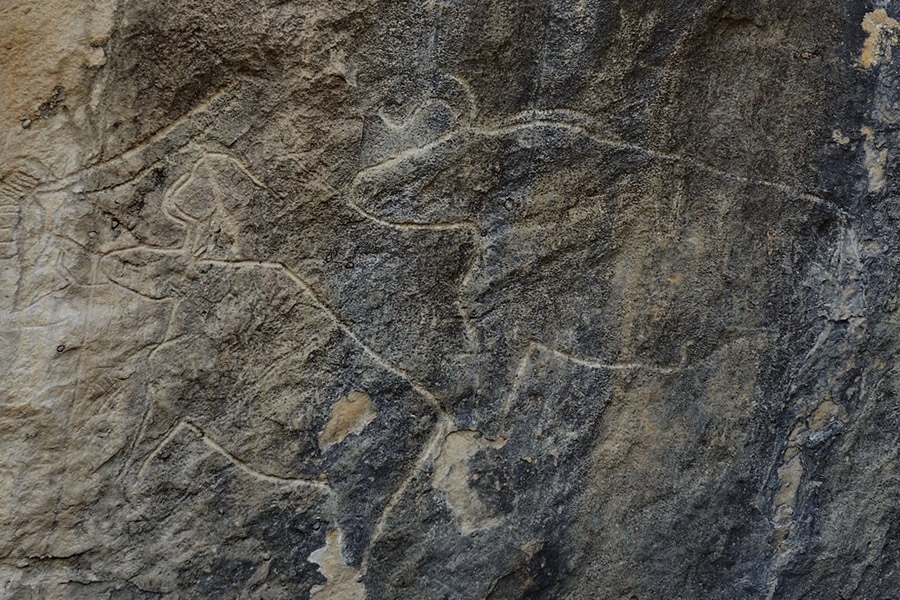
Gobustan petroglyphs describe an ancient Azerbaijan culture in manuscripts that reached us through millennia. Already in the Mesolithic Era, unknown artists captured significant moments of community life on stones. The drawings reflected hunting, environment, ritual customs, dances and others. Stone and ceramic figures of people and animals have been preserved dating back to the epoch of Neolithic. There are remains of the ceramic dishes of that period in the museum archives discovered on the territory of the modern Azerbaijan.
Azerbaijan culture
Azerbaijan culture
Azerbaijan culture

Islamic culture

Culture of Azerbaijan has also been formed under the influence of Islamic traditions. During the period of Arab conquest, many architectural constructions have appeared: mosques, mausoleums, minarets. Geometrically correct shapes of the buildings were adorned with exquisite patterns and arches. Later t regional schools were established; each region had its unique style. For instance, sculptors of Nakhichevan paid more attention to the finishing of the buildings using ceramics. Masters of shirvan-apsheron school would stand out with succinct combination of architectural forms and smooth walls.
Islamic culture of Azerbaijan flourished in the period of the Seljuk state. Today tourists enjoy the rich legacy inherited from the architects of that time: mausoleum in Juga, Momina-khatun mausoleum, Yusuf ibn Kesseyir mausoleum. Famous Maiden Tower in Baku was also constructed in the times of Seljuks. Few centuries later, the stone legacy was replenished by Nardaran fortress, round castle (Mardakyan), “Bail rocks” and others. Ceramic schools of Azerbaijan, namely Bailakan and Ganja, were born in that period. Classics of Persian literature and poetry had a great impact on the Azerbaijan art. Namely, Shirvani, Ganjavi and of course, Nizami with his well-known cycle of five poems “Khamsa”.

Applied arts

Azerbaijan traditions found its reflection in the décor interior: house walls of wealthy people were decorated with exquisite patterns with elements of planting motives. Carpets were indispensable attribute of each house regardless of the welfare of its owner. Azerbaijan carpets are still a signature of the country as well as the most spread local craft. Thanks to popularity of this applied art in Azerbaijan, there are several schools of carpet weaving known beyond the country. The best exhibits adorn private collections and halls of the famous museums of the world.
Azerbaijan culture
Azerbaijan culture
Azerbaijan culture
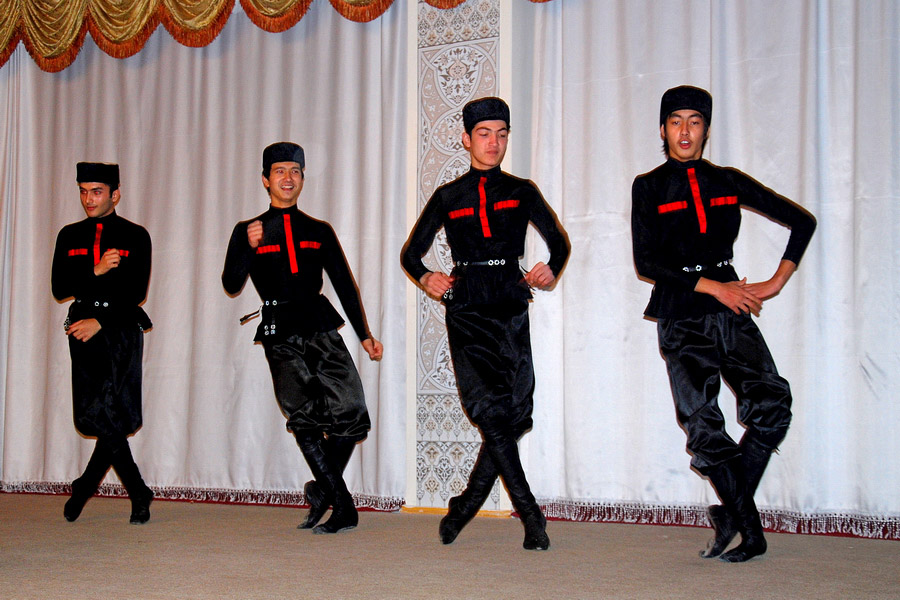
Azerbaijan national costume deserves a special attention. Clothing elements and range of colors differed from region to region. But in general, the costume highlighted modest charm of women and natural strength of men, as well as Azerbaijan customs. Jewelry art of Azerbaijan has elements of traditional Arab décor, but has distinguishing marks. They are mostly big in size and elegant with filigree articles, enamel and precious stones.

Music and Theater

Music culture of Azerbaijan is so significant that traditional mugams (folk musical compositions) are enlisted in the UNESCO Cultural Heritage and compositions of Azerbaijan authors are played in concert halls of the whole world. Development of Azerbaijan music is tightly connected to the history of Azeri literature and poetry. As mugam is an art that combines epics of eastern poets and a musical improvisation in a particular local way.
Azerbaijan culture
Azerbaijan culture
Azerbaijan culture
A special highlight of Azerbaijan culture is theatrical art. Its history encounters many centuries, originating as a folk theatre. Simple scenes showed life of working people mixed with Azerbaijan traditions and customs. On public holidays and outdoor merrymaking, theatrical groups organized small satirical staging that reflected moral values. It is no surprise that with such a rich history, Azerbaijan theatre today offers plays in different styles and outstanding performance.
Diversity of Azerbaijan culture is just a small part of the great legacy that this beautiful Land of Fire conceals. In the journey, make sure to touch spiritual piece of Azerbaijan to get a deeper insight into its history, values and life. 
  • 0 Comments

  • 0 Comments
Older Posts Home

About Blog


Hi! I'm Paul Harrington

An adventure travel photographer, professional blogger, and digital nomad.


Hi! I'm Paul Harrington

search

Subscribe Us

Labels

Architecture Art & Culture Azerbaijan Baku City Tour Guides Cruisine Flights Health Tours History Holidays Hotels Hunting Tours Museums News Regional Tours Regions Religion Shipping Shopping Sports Tour Tour-Package Tour-Program Travel Planning Trips
Created with by OmTemplates | Distributed By Gooyaabi Templates